The Hill Remembers: Chalk Giants and the Art of the Campaign Anchor
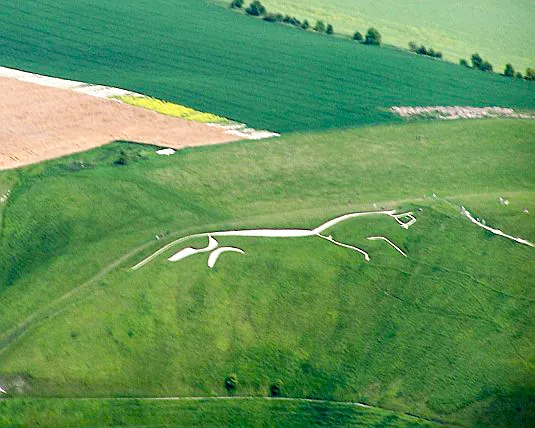
Photo: Dan Huby , Public domain, via Wikimedia Commons
A map pin is a passive thing. You stick it on a hill, name the hill, and move on. A chalk figure is not passive. It is a hole in the turf that only stays a figure because somebody keeps cutting it. Stop scouring the Uffington White Horse and the chalk silts up, the turf creeps back, and the horse becomes a rumour with a nice view. That is the first lesson for anyone building a fantasy map: some landmarks are not places, they are obligations.
Why a hillside giant beats a castle pin
Fantasy maps are littered with castles, towers and ruined temples. They look great on the page and do very little at the table. A chalk figure is different because it is made of negative space. You do not build it; you uncover it. The hill was always chalk. The figure is a decision about what to remove.
That gives you three things a castle rarely gives you. First, a silhouette people can see from the next ridge, which means travellers arrive with expectations before they arrive with questions. Second, a maintenance loop: somebody has to cut it, weed it, argue about its edges. Third, a history of edits. The Long Man of Wilmington has been redrawn, restored and debated for centuries; dating is contested, meaning is contested, and the figure has been altered by the people who claimed to be preserving it. That is not a flaw in the lore. That is the lore.
In campaign terms, a chalk figure is a map anchor with a clock attached. It is visible, it is contested, and it will change if nobody tends it.
The lore is in the maintenance, not the monument
Real chalk figures are surrounded by scouring festivals, local pride, parish arguments and occasional vandalism. Who pays for the re-cutting? Who gets photographed doing it? Which version of the figure is the 'correct' one? These are not dry administrative questions. They are faction politics with better scenery.
For a tabletop group, that means the landmark can function as a recurring character without ever speaking. A village swears the figure faces the sea to warn off raiders. A neighbouring village insists it faces inland to call the harvest. A third group says both are wrong and has the deed poll to prove it. Every few years the figure is re-cut, and whichever story is loudest at the scouring festival becomes the official version until the next re-cutting.
That is brilliant for RPGs because it makes the map unstable in a way that feels earned. You do not need a wizard to move the mountain. You just need a committee with strong opinions and a spare weekend.
Inventing your own: borrow the grammar, not the gift shop
The lazy move is to file the serial numbers off a National Trust property. A white horse becomes a white stag. A long man becomes a tall woman. Congratulations, you have made a postcard, not a landmark.
Better to borrow the underlying grammar. Chalk figures work because they combine local geology, communal labour, disputed meaning and a ritual calendar. Swap the materials and keep the tension. A salt figure cut into an estuary mudflat, re-dug every spring by two villages who disagree about whether it is a warning or a welcome. A peat-cut sigil on a moor, maintained by a family who have done it for generations and are now too old to continue. A quarry face carved into a sleeping giant, except the quarry company keeps changing the drainage and the giant’s expression has shifted.
When indie designers ask how to make a landmark feel real, the answer is usually not more backstory. It is more stakeholders. Give the landmark three names, two rumours and one obligation. Name it what the nearest village calls it, what the map calls it, and what the older people call it when they think nobody is listening. Add one rumour about what happens if the figure is ever completed. Then add the obligation: a festival, a tax, a pilgrimage, a debt. That obligation is what turns a doodle into a destination.
At the table: running a landmark that remembers
If you are running a campaign in 2026, try treating the landmark as a faction rather than scenery. Give it a simple clock with four segments. Each time the players travel past, each time a season turns, each time a local dispute goes unresolved, fill a segment. When the clock fills, the figure is re-cut, and one rumour about it becomes true. That is it. No stat block required.
Players can then interact with the landmark in ways that are not combat. They can defend it from vandals, fund its maintenance, steal the chalk, reinterpret its shape, or campaign to have it redrawn to suit their own prophecy. A re-cutting session makes excellent downtime. Ask each player what their character thinks the figure depicts, and write down the answers. Later, have an NPC insist on the least popular answer. Instant conflict, zero prep.
The best bit is that the players’ own interpretations can become canon. If they spend a session arguing that the figure is a warning against a local river spirit, then the next re-cutting can subtly incorporate that reading. The map remembers what the table said. That is a powerful trick, and it costs nothing but attention.
The UK lens
Britain is unusually good at this sort of landmark because the landscape is full of things that are half natural, half maintained, and entirely argued over. Chalk downland gives you figures. Moorland gives you crosses and boundary stones. Coastal paths give you turf mazes and lost chapels. Some are ancient, some are Victorian, and some are modern follies with a good publicist. That mixture is the point. Fantasy does not need authenticity; it needs layers.
So do not simply copy the famous ones. Steal their social life instead. Ask who cuts the grass, who signs the cheque, who brings the flask, and who mutters that it was better in the old days. That is where the lore lives.
A good campaign map is not a list of places. It is a list of things people argue about. Chalk figures remember because they are never finished. Make your landmarks unfinished too.