Half-Eaten Lettering: Why Your Next Fantasy Town Needs a Ghost Sign
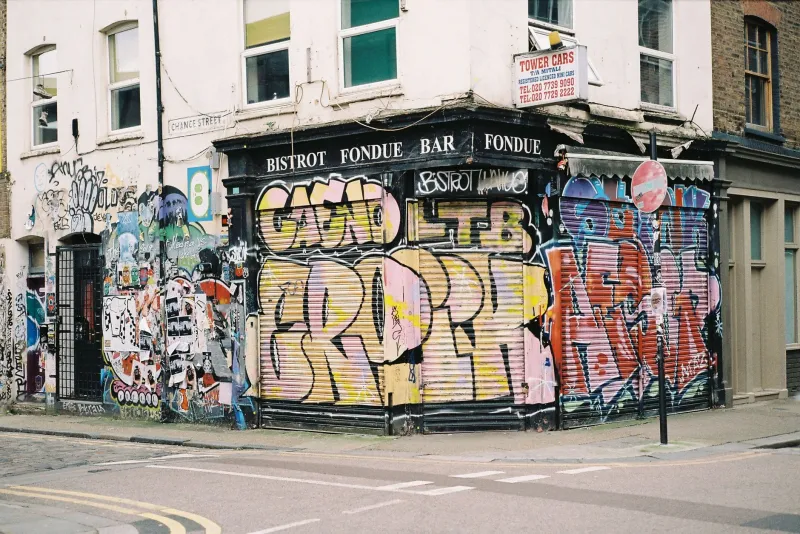
Walk down any British high street and look above the shopfronts. Past the plastic fascias and the charity shop boards, there’s another town up there: painted names in flaking white, half-swallowed by brickwork, advertising soap, sausages, ales and insurance companies that no longer exist. These are ghost signs, and they are one of the best free worldbuilding resources in the country.
Not because they’re pretty — though many are — but because they show you how a place accumulates history in public. A ghost sign is a layer. It’s a commercial decision from decades ago, preserved by accident and partly erased by later decisions. That’s exactly what a good fantasy town should feel like.
The Brick Remembers What the Shopfront Forgot
A ghost sign is rarely alone. Look closely and you’ll often find three or four strata on one building: an old painted advert on the gable end, a newer painted sign beneath it, a 1970s plastic fascia bolted over the lot, and a modern vinyl banner flapping above the door. Each layer was once the latest thing. Each one was later covered up by someone who thought the old sign looked dated.
The worldbuilding lesson is simple: don’t design a town as a single era. Design it as sediment. The blacksmith’s forge didn’t vanish because the worldbuilder deleted it; it vanished because a tannery moved in, then a printer, then a vape shop. The building kept the shape of the old use. So should your town.
When you’re building a settlement for a tabletop campaign or an indie game, resist the urge to make every street coherent. Coherence is for brand guidelines. History is messy. A town square with a faded mural for a grain co-operative, a newer statue to a local hero, and a car park where the co-operative’s warehouse used to be tells a story without a single line of dialogue.
Read the Layers, Not the Words
Ghost signs are a palimpsest — a surface written on more than once, with the earlier writing still faintly visible. The trick is to read the layers rather than decode the words. You don’t need to know what ‘Palethorpe’s’ sold to understand that the building once served a different market, at a different scale, to a different kind of customer.
Next time you’re waiting for a bus, try this. Pick one building. Note what’s advertised on the oldest visible layer. Note what covers it. Note what that covering implies about money, fashion or regulation. A hand-painted sign for a local brewery, overpainted by a national chain’s logo, is a story about consolidation. A sign for a family business half-hidden behind a fire escape is a story about safety rules arriving after the fact. A faded advert for a product nobody remembers is a story about taste.
In fantasy terms, that’s a guild monopoly, a regulatory crackdown, or a fashion shift. You don’t need to explain it in a lore bible. You just need to leave the evidence on the wall.
Partial Legibility Is the Whole Point
The best lore is the lore you almost can’t read. A ghost sign works because it withholds. You catch a fragment — ‘…CLEANER’, ‘…& SONS’, ‘…EST. 1897’ — and your brain fills the gap. That gap is where the player’s imagination does the work, and it’s far more powerful than a paragraph of exposition.
This is the opposite of how a lot of fantasy worldbuilding works. We tend to over-explain. We write the full history of the Silvermark Trading Company, its founding charter, its CEO’s favourite colour. And then players skim it. But a damaged sign, a half-erased map, an NPC who misremembers the name of the old road — those things invite investigation. They make the world feel bigger than the handout.
So build in damage. Let the party find a tavern sign that’s been repainted so many times the original name is a ghost. Let the original name be in a dialect word nobody uses any more. Let one NPC insist it was always called the King’s Head, and another swear blind it was the Green Man, and let both be partly right. That’s not a plot hole. That’s a place with a memory.
Three Prompts for Your Next High Street Walk
If you want to turn a lunch break into campaign prep, try these.
One: Invent three former tenants. Pick a single building with a ghost sign. Write down three businesses that occupied it before the current one. Give each a reason for leaving — rent, death, a scandal, a road being rerouted. You now have three adventure hooks and a reason for the building’s weird back extension.
Two: Find the contradiction. Look for a ghost sign that disagrees with a nearby plaque, conservation area appraisal or local history society notice. One of them is simplifying. Which one, and why? In your campaign, that’s a faction trying to control the narrative of a town. The players can side with the plaque or the paint.
Three: Write only what you can prove. Photograph a sign at an angle where it’s almost illegible. Then write a handout using only what the photo actually shows — no extra lore, no confident guesses. Hand it to your players and let them speculate. You’ll be surprised how much they invent from three visible letters and a bricked-up window.
From High Street to Hex Map
When you map this onto a campaign, think of it as the archaeology of commerce. Trade routes leave marks. Obsolete products leave marks. Changing tastes leave marks. A town that made its money from one thing and is now pretending to make it from another is a town with a secret, and the secret is usually written on the side of a building.
For indie developers, ghost signs are a masterclass in environmental storytelling. You don’t need a codex entry. You need a decal of an old logo, half-covered by a newer one, on a wall the player will walk past twenty times. Players who notice will feel clever. Players who don’t will still feel the texture of the place. That’s efficient design.
In 2026, as high streets keep shifting under our feet, the ghost signs are getting rarer and more precious. Some councils are restoring them. Some developers are painting over them. Either way, they’re a reminder that a town is not a finished product. It’s a conversation between generations, and most of the best bits are the bits that haven’t been tidied up.
Don’t Restore It
The temptation, once you start noticing ghost signs, is to make them crisp. To write the full history. To explain the joke. Resist that. The power is in the half-eaten lettering, the missing word, the sign that has been weathered into abstraction.
So next time you’re building a fantasy town, leave a wall unpainted. Put a faded advert on it for a product your players will never see. Let the rain bleed through the new regime’s slogans to reveal the old ones underneath. The best lore is the lore you almost can’t read — and Britain’s high streets have been teaching that lesson for a hundred years.