The Country Is Already Mapped: Running Campaigns Along the Pylon Line
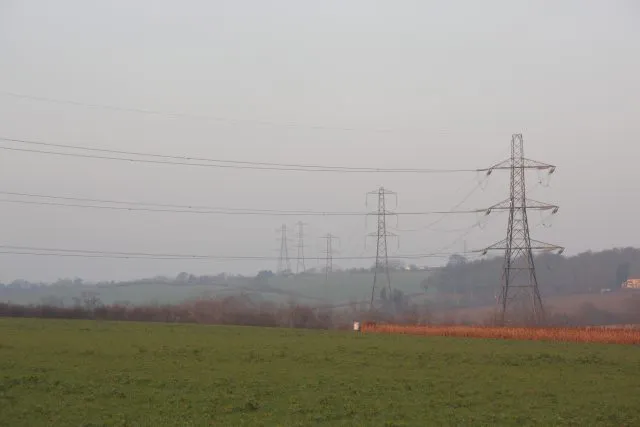
Photo: Peter Walker, CC BY-SA 2.0, via Wikimedia Commons
Drive any A-road in Britain for twenty minutes and you will see them: steel lattices stepping across fields, carrying cables from one horizon to the next. Most of us file pylons under scenery. For a GM, they are something better. They are a map language that already exists, complete with nodes, borders, hazard markings and a hierarchy of power. In 2026, when so much fantasy cartography still looks like a variation on the same old parchment, the grid offers something sharper: infrastructure you can point at from a lay-by.
The Pylon Is a Hex With a Job
A pylon is not just a marker. It is a marker with a function, and that function gives it weight. Suspension pylons carry a line straight; tension or terminal pylons anchor it, change its direction or hand it off to a substation. Some are tall, some squat, some have ladders and platforms that look like they belong in a dungeon. The little numbered plates on the steel legs are the best bit. They are asset identifiers, maintenance breadcrumbs, proof that someone has to climb up there and check things.
Use that. In a campaign, every pylon can be a named node with a capacity, a condition and a keeper. The plate number becomes its true name. Villagers might call it the Long Leg or the Hissing One, but the survey map says 4ZK 117. That tension between folk name and official designation is free lore. It tells players there is an administration behind the landscape, and that administration has a filing system.
Wayleaves Are the Borders You Can Walk
Here is the detail that makes the grid so useful for tabletop play: the line does not own a strip of land in the ordinary sense. It has a wayleave, an agreement that lets the operator run cables across private ground. The land underneath can still be farmed, walked or argued over. That makes the pylon line a border that is visible from above but porous at ground level.
For a campaign map, that is gold. A wayleave corridor can be a trade route, a disputed path, a place where two factions both claim the right to cross. It is not a wall. It is a permission, and permissions can be withdrawn. Drop a village council, a landowner and a grid maintenance crew into the same corridor and you have a political adventure without a single monster. For competitive arena layouts, a wayleave is a lane: fast, open and dangerous because everyone can see you use it.
Substations Are Walled Towns With a Hum
If pylons are the road network, substations are the castles and market towns. They are fenced, signed, humming and deliberately unglamorous. That is exactly why they work as fantasy architecture. A substation has thresholds, controlled access, warning notices, transformers that look like armoured beasts and a constant low sound that puts people on edge.
Do not make every substation a dungeon. Make them settlements. Some are small: a fenced compound behind a hedge, a single transformer and a gate that sticks. Some are regional hubs with cameras, lights and a control room. The hierarchy is already there. Translate it directly. A 400kV substation is a capital. A 132kV site is a market town. A pole-mounted transformer on a wooden post is a hamlet with one suspicious elder.
For arena design, substations give you objectives that are not just capture points. They are places where energy is converted, contained and redistributed. A team that holds the transformer yard controls the flow. A team that holds the gate controls access. A team that holds the fence line controls information. That is three kinds of territory in one compound.
Voltage Is a Threat Level You Can See
One of the grid's best lessons for GMs is that risk can be legible without being explained. A 400kV line is not more dramatic because someone reads out a number. It is dramatic because the pylons are bigger, the cables sag differently, the wayleave is wider and the substation has more warning signs. The landscape itself tells you the stakes.
Use that principle in fantasy maps. Do not label every region as low, medium or high risk. Show it. A road with one thin cable and a wooden pole feels local. A corridor of steel pylons marching to a fenced compound feels strategic. Players learn to read the map with their eyes, not their character sheets. In competitive layouts, the same trick works: the central objective should look different, not just be marked differently.
Numbered Plates and the Lore of Maintenance
The small stuff is where the story lives. Asset plates. Faded safety signs. A track worn through the grass by a maintenance van. Graffiti on a concrete base. A padlock that has been cut and replaced. These details imply a world that continues between adventures, with budgets, schedules and arguments about access.
When you build a pylon-line campaign, give each node three things: a name, a function and a problem. The name can be official or local. The function is what the node does for the grid, the settlement or the faction. The problem is why the players are there. A tension pylon with a cracked base. A substation with a gate left open. A wayleave dispute that has turned nasty. That is enough to run a session without a bestiary.
Building the Line at Your Table
Start with a real map. Pick a stretch of grid between two towns you know, or invent one using the same logic. Mark the pylons as nodes, the substations as hubs and the wayleaves as corridors. Give each hub a faction that wants something from the flow of power: the operator, the landowner, the local council, the people who live in the shadow of the cables. Then ask what happens when the flow stops.
For competitive play, sketch the same line as an arena. Pylons become sightline blockers and capture nodes. Wayleaves become lanes. Substations become fortified objective zones. The energy does not need to be a mechanic. It can be the reason the layout exists, the thing everyone is pretending to protect while they fight over the ground beneath it.
Britain's grid is not a fantasy map. It is better than that. It is a working map, full of permissions, hazards and maintenance schedules, and it has been drawn across the country in steel. Read it closely enough and you will never need another blank hex again.